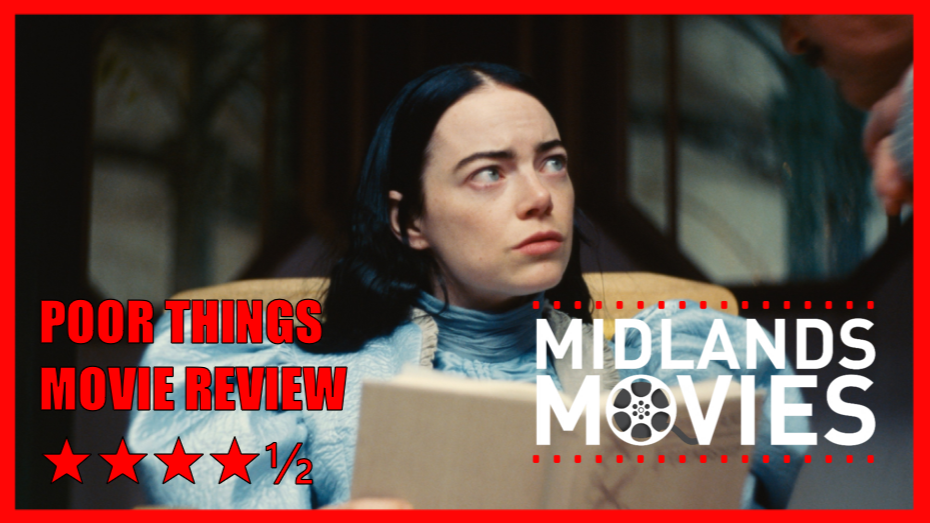

Review of Poor Things

midlandsmovies • February 5, 2024

Poor Things (2024) Dir. Yorgos Lanthimos


The filmography of Yorgos Lanthimos has often turned to bodily autonomy in the director’s efforts to tell weird, often disturbing stories. This is often combined with a musing on the nature of innocence, harking back to his third film Dogtooth (2009).


After the more austere – but no less funny – The Favourite (2018), Poor Things is a return to the darker and more surreal. Based on Alasdair Gray’s novel, it follows Bella Baxter (Emma Stone), a reanimated young woman with the brain of an infant. Her father-figure/creator Godwin ‘God’ Baxter (Willem Dafoe) keeps her locked away, claiming to protect her from the outside world, while his assistant Max McCandles (Ramy Youssef) holds a candle for Bella.


It's a career-best performance for Stone, who has a physically demanding role, highlighting the contrast of Bella’s adult body and developing motor skills with stilted movements. This is particularly clear in an excellently choreographed dance sequence at the half-way point of the film.


The crux of the story comes when Bella undergoes a sexual awakening, leading to her escaping from God’s house and travelling Europe with Duncan Wedderburn (a wonderfully camp, caddish Mark Ruffalo). At no point is the audience allowed to forget that Bella is a child, albeit a child that bodily is of age. Her development and experiences are constantly at the forefront of the film.


This has caused some controversy. The Guardian called on cultural commentors to discuss whether its was feminist, due to its discussions on consent and female autonomy, or a misogynistic film that fetishes Bella. In some ways, it is both. Despite the fantastical nature of the story and almost steam-punk settings, Poor Things is set in Victorian London primarily. A time when women were considered property.


Misogynistic views are rife, and the male characters are clearly looking to take advantage of Bella. God admits that his sexual urges are only kept in check due to his paternal feelings for her. Duncan sees her as a simpleton and innocent and takes advantage of her burgeoning sexuality. Even the good-natured Max is predatory in his infatuation.


Yet the film is quick to skewer these characters. They are routinely mocked and outclassed as Bella continues to develop. Her innocence often leads to bluntness and while she is a child in very adult situations, this childishness is vocalised with pure common sense. Bella sees how female sexuality has been policed and cannot comprehend it – why do it if it is not enjoyable, and why not do it frequently if it is? She sees injustice of all sorts and takes the most direct route possible to solve it.


Is Poor Things uncomfortable? Frequently. But it is supposed to be. And Tony McNamara’s script is often quick to balance the more disturbing sequences with equally uncomfortable laughs. It doesn’t offer a perfect answer or solution to its themes, nor does it moralise the characters. By the end of the film, which flies through its extended runtime, Poor Things sparks conversation amongst the audience. Something that is often missing from modern cinema.


★★★★½


4.5 / 5


Matthew Tilt

Twitter @Matthew_Tilt
By midlandsmovies December 8, 2025
On the 4th of December 2025, as the cold moon rose, evil spirits and terrifying creatures lingered in the darkness. In rural Derbyshire, the full moon welcomed in the premiere of The Winster Werewolf – Amberwell Productions' new short, the fourth in their six-part ‘creature anthology’.
By midlandsmovies December 7, 2025
Sarah Hughes is a Midlands-based actress & TV, film and SFX artist is about to begin production on her first ever full feature film.
By midlandsmovies December 6, 2025
As part of our Midlands on the Move features, we speak to Carl Staples, a Midlands storyboarder and filmmaker with a wide range of regional experience who went on to be involved in the Oscar-winning short film The Silent Child. Find out more about Carl's work...
By midlandsmovies December 4, 2025
Our resident local film critic @_jacob.holmes headed off beyond the region's boundaries to the BFI London Film Festival. In our latest Midlands on the Move feature, Jacob shares some helpful hints for first timers, as he provides a guide for local filmmakers and film fans as to what to expect when visiting events further afield... In 2025 I had the honour of attending the 69 th BFI London Film Festival for a week, I attending premieres for some of my most anticipated films of the year. And even grabbed a press pass too. This wasn’t my first film festival, but this was my first London Film Fest and to be brutally honest, in the build-up, I was nervous! Sadly, I found the BFI and Accreditation websites not very intuitive and quite confusing. So this this article hopes to give some peace of mind and let people know what they can expect when attending such UK festivals - both as a regular guest and as press. Tickets Getting regular tickets can be stressful, akin to a big concert. And in a way it's like the Hunger Games, a survival of the fittest type of vibe. First off, BFI advertise tickets go on sale at 10am in September, which is true but not wholly accurate. Instead, at 9am you head to the website and get put in a waiting room with a random allocated number for when the actual sale start at 10am. At that time it tells you where you are in the queue. If you get lucky, you could wait 15 minutes, but often the wait can be an hour plus. Finally when you can make a purchase, you are let in and can put all tickets into your basket. I have two years of experience with this queue! The first time, I failed completely and all movies I wanted to see were sold out. But this year I had a plan! The key to success is knowledge to how to play the game. Tip 1: For the best possible chances, subscribe to the BFI and become a member. The year membership was £35 at its cheapest. And if you're in the Midlands like I am, outside the festival a membership can be fairly useless unless you go to London often. But what this membership gives you is important. A week before general release there is a presale for BFI members. Not only is this a benefit, it also gives you a crucial second chance. By that I mean if things don't go your way the first time, you can try again in the general sale. And I had to do exactly this. When general admissions came out, I tried again for tickets for Wake Up Dead Man and got my ticket! Tip 2: Quantity. There's nothing against the rules saying you can’t enter the queue on multiple devices! I was placed very low down in the queue in my first year on one laptop, but this year I used my phone, PC, laptop, my friend's laptops AND my friends' devices! But it all paid off. Devices can take 2 hours or only 30 minutes. More Devices = Higher chance of getting tickets. Tip 3: Know the films you want to see beforehand. If you don’t know what films you want to see or when they screen you will be completely lost. Write a timetable - and furthermore, have back up plans. Sometimes you'll click on what you want and it will be sold out, but having a backup plan will be much easier overall. Tip 4: Even if you don’t get tickets, it's not the end of the world. There are plenty of second-hand ticket websites selling tickets at normal (or sometimes cheaper) prices. Websites like Twickets, social media accounts like @LFFstubs on X or the r/londonfilmfestival on Reddit will have second-hand tickets. In fact, I sold one of my tickets on Twickets and had no complaints either. Press passes As you can imagine, this process is very different for industry passes. The biggest issue is tickets go on sale in waves each day. Instead of one go, pass holders book their tickets day by day. Tickets go on sale at 8am two days before, usually taking place on the accreditation app or website. In some ways this is easier, but it's also a gigantic pain. Although it's MUCH easier to get a ticket, do have to wake up every single day to go onto a laggy website and book a few tickets. You may even have to book tickets in the cinema. Another issue can be if you plan to see both general and press screenings. One you book way in advance, but press screenings are booked during the fest. Ticket prices for public screenings vary, but the gala/premiere screenings are usually £30-£40. Whilst the press screenings are completely free, you just have to pay for the pass itself which is around £55.
Show More